GTO Fundamentals -The AKQ Game
A three-card toy that solves real poker
There's a moment in every poker player's life when "bluff a third of the time" stops sounding like advice and starts sounding like a chord progression — something you know the shape of but couldn't write down.
This post is about the smallest possible game where that chord becomes a note you can hear. Three cards. One bet. Two formulas that fall out of the algebra and never leave you.
The game
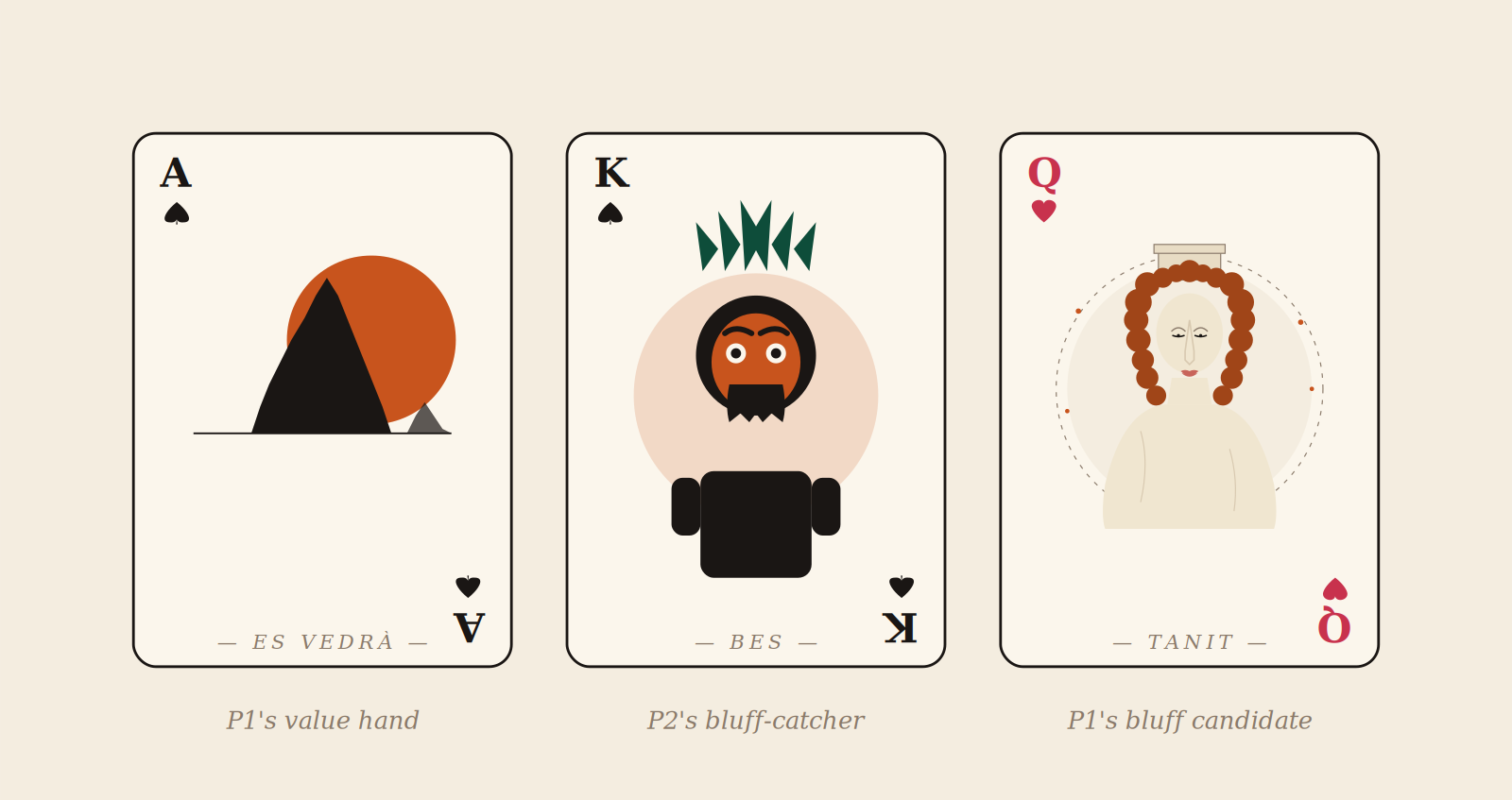
Two players. Three cards: an Ace, a King, a Queen.
P2 is dealt the King, always. P1 is dealt either the Ace or the Queen, each with probability one-half. P2 doesn't know which.
The pot starts at $1. P1 can check — in which case the cards are turned over and the higher one wins — or P1 can bet $1. If P1 bets, P2 must call or fold.
That's the whole game.
The Ace always wins at showdown. The Queen always loses. The King only beats the Queen.
So the Ace is pure value, the Queen is pure bluff candidate, and the King is the bluff-catcher. P1 is choosing between betting for value (with the A) and bluffing (with the Q). P2 is choosing whether to pay them off.
The whole game collapses to two questions: how often should P1 bluff the Q, and how often should P2 call with the K?
The payoffs
Before the math, the picture.
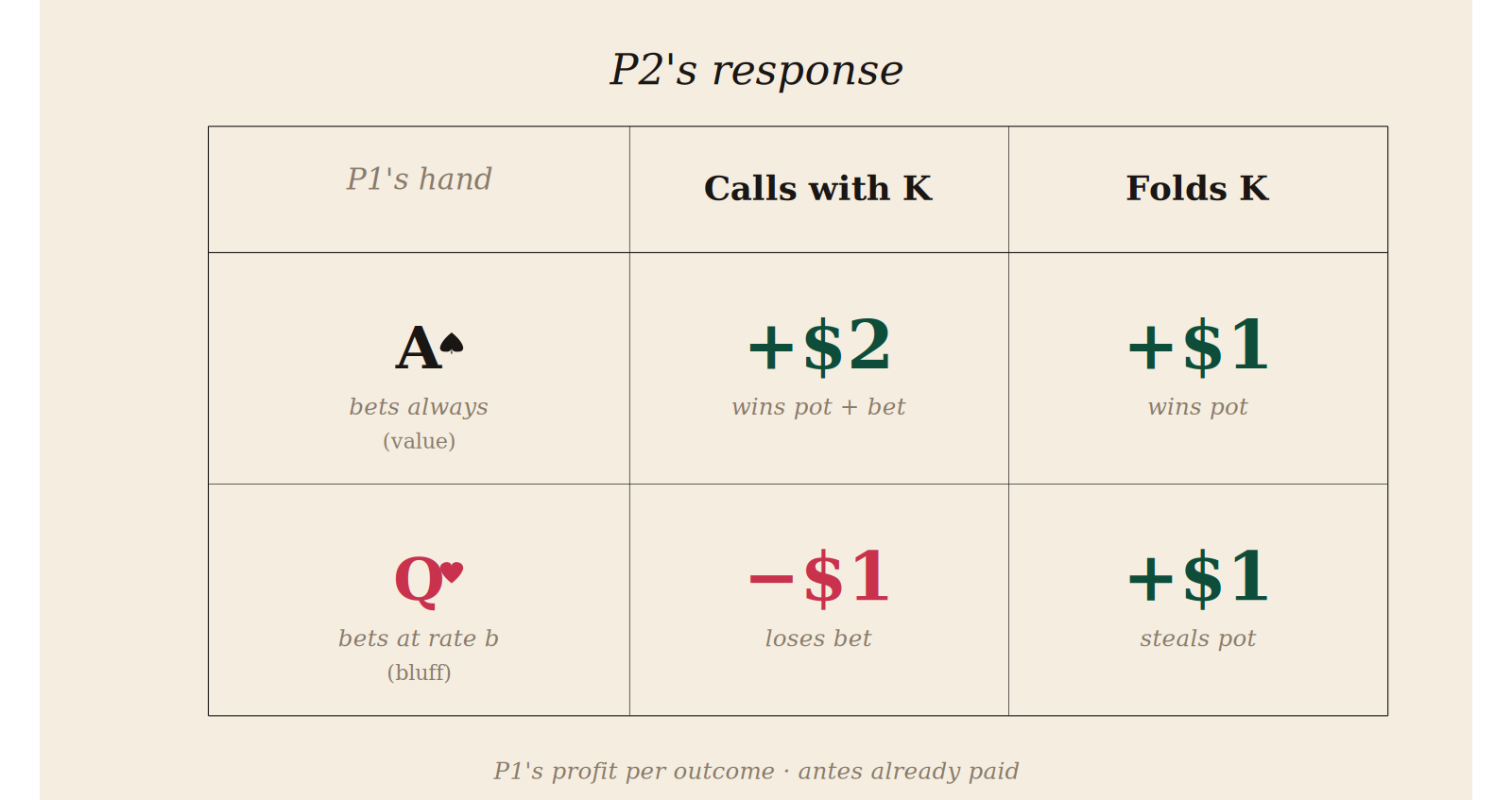
Read the matrix like this. P1's row is the hand they were dealt. P2's column is the action they took. Each cell shows P1's profit in dollars, ignoring the antes already lost.
The trick: P1 is mixing strategies on the Q, and P2 is mixing strategies on the K. Neither side knows what the other will do this hand. The equilibrium is the pair of frequencies that makes both players indifferent.
Solving for the bluff frequency
Let b be the probability P1 bluffs the Q.
P2 sees a bet. From P2's seat, the bet could be an A (P1 has A with probability 1/2, always bets) or a Q being bluffed (P1 has Q with probability 1/2, bets at rate b).
Using Bayes:
P(bluff | bet) = (1/2 · b) / (1/2 + 1/2·b)
              = b / (1 + b)
For P2's K to be indifferent between calling and folding — the GTO condition that makes the strategy stable — the EV of calling must equal the EV of folding, which is zero.
If P2 calls, they risk $1 to win $2. They win when P1 was bluffing, lose when P1 had value:
EV(call) = [b/(1+b)] · 2 − [1/(1+b)] · 1 = 0
Solve:
2b = 1
b = 1/2
P1 bluffs the Queen exactly half the time.
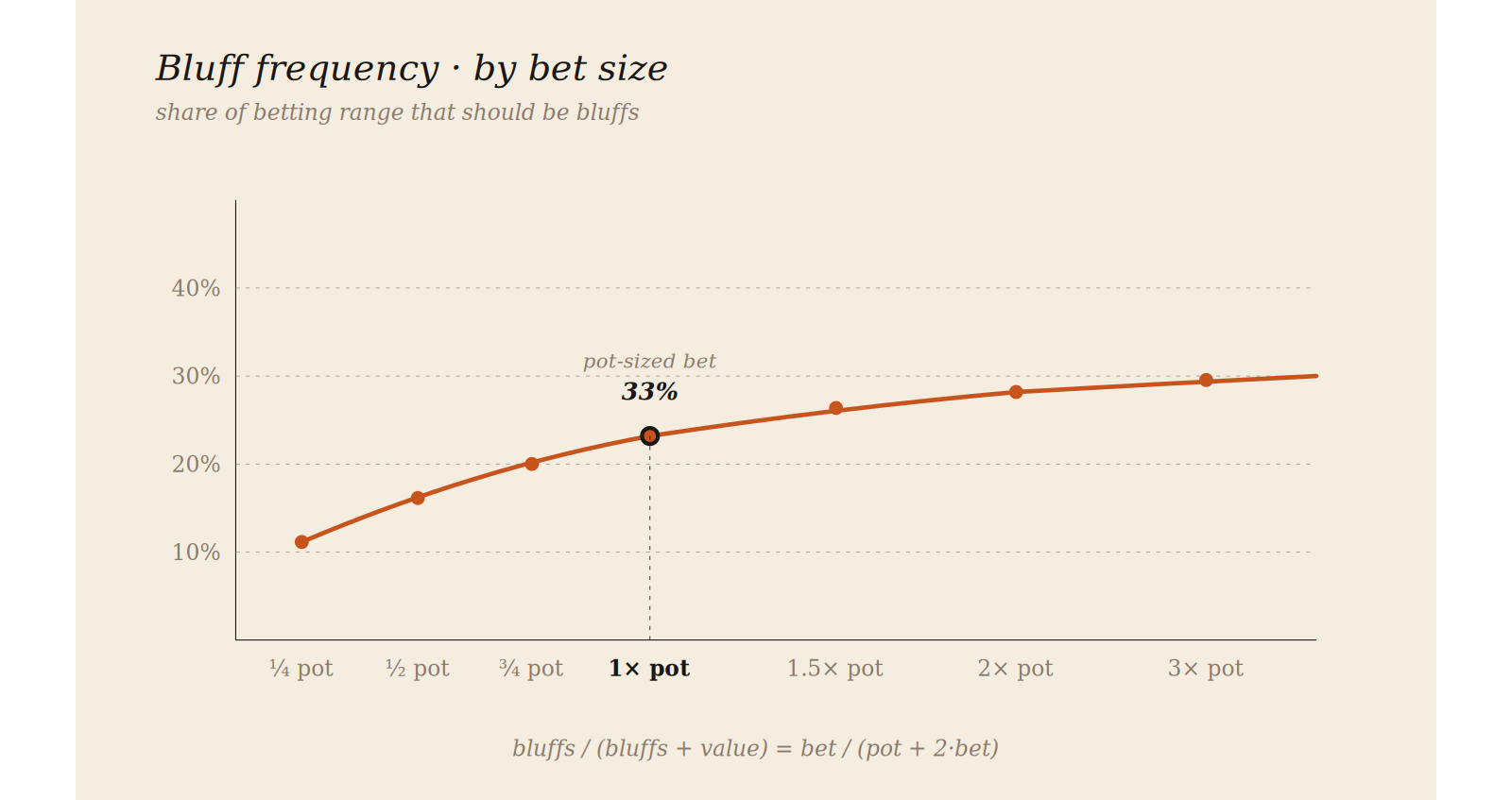
P1 bets the A 100% of the time and the Q 50% of the time, weighted equally in the deal. So inside P1's betting range, value makes up two-thirds and bluffs make up one-third.
That ratio is not a coincidence. It's the general rule, written below for any pot-to-bet ratio.
bluffs / value = bet / (pot + bet)
For a pot-sized bet, that's 1/(1+1) = 1/2, meaning one bluff for every two value bets — the 33% bluffs you've heard before.
Solving for the defense frequency
Now from P1's side. Let c be P2's calling frequency with the K.
P1 holds the Q. Checking the Q wins zero (it always loses showdown anyway). Bluffing the Q risks $1 to win the $1 already in the pot. P1 wins when P2 folds, loses when P2 calls:
EV(bluff) = (1 − c) · 1 − c · 1
For P1 to be indifferent between bluffing the Q and giving up:
(1 − c) − c = 0
c = 1/2
P2 must call the King exactly half the time.
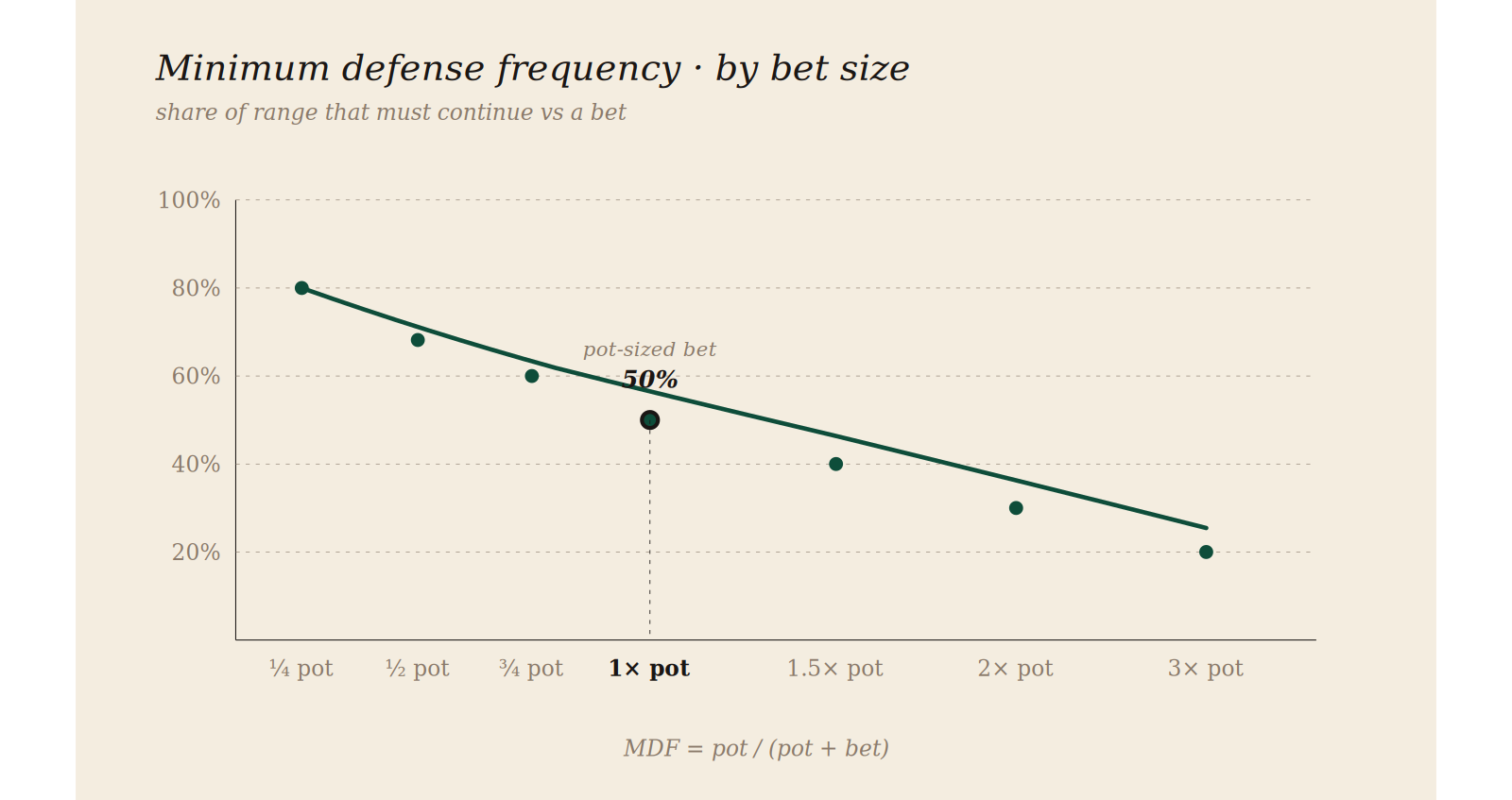
That 50% is a special case of the more general law — the one you should tattoo somewhere visible.
MDF = pot / (pot + bet)
Minimum Defense Frequency. The fraction of your range you must continue with to deny the bettor an auto-profit with any two cards.
- Quarter-pot bet → defend 80% of your range
- Half-pot bet → defend 67%
- Pot bet → defend 50%
- Two-times-pot overbet → defend 33%
Why this matters in your sessions
Three takeaways from one tiny game:
The first is that your bluff frequency is a function of your bet size, not your read on villain. Bigger bets need more bluffs to balance, smaller bets need fewer. If you triple-barrel pot on the river, your range should be a third bluffs. If you go 2x pot, closer to 40%.
The second is the inverse, from the calling seat. Against small bets you must defend wide — folding too much against a 1/4-pot bet leaks money on every street it happens. Against overbets you can fold a lot more than feels comfortable.
The third is the most important and the easiest to forget: this whole framework describes unexploitable play, not maximally profitable play. At NL10–NL50, the population overfolds rivers and underbluffs turns. So the answer to what should I do at the tables tomorrow morning is not "bluff exactly 33%." It's: know what the equilibrium says, then deviate from it on purpose, in the direction your reads point.
GTO is the home base. Exploits are the road trip. You have to know where home is before you can leave.
— grinding NL10 in Ibiza · one indifference condition at a time